Tuesday, September 29, 2020
Mia L. Bagneris Director of Africana Studies

Carroll Gallery pop-up events - Fall 2020

On Thursday, October 22nd, join us for Recycled Journal Making. Stop by and make a small hard-cover journal out of recycled cardboard and hardware.
On Thursday, November 12th we will make Solar Prints. Gather materials to create a photogram using light, water, and photo-s ensitive paper. Inspired by Man Ray’s Rayographs.
All pop-up events are open 9:00 am – 4:00 pm in the Carroll Gallery.
Free and open to the Tulane community.
Social distancing: Limited to 10 people at a time in gallery.
Michelle Foa: Edgar Degas and the Matter of Cotton
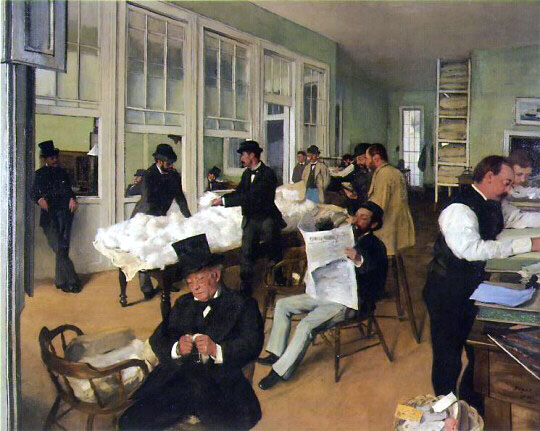
Michelle Foa's article "In Transit: Edgar Degas and the Matter of Cotton, between New World and Old," was just published in the September 2020 issue of The Art Bulletin. Edgar Degas’ four-month stay in New Orleans in 1872-73, which marked his first experience crossing the Atlantic, resulted in two remarkable paintings of a cotton office. Foa’s article analyzes the important connections between Southern cotton, the textiles that fill the artist’s pictures of dancers, laundresses and bathers, and the paper he used for many of his drawings.
This year she has given lectures at the Montreal Museum of Fine Arts (virtually) and Wofford College. In July she joined the Board of Directors of the National Committee for the History of Art.
Tuesday, September 1, 2020
Representation and Resistance: Scholarship Centering Race in Western Art

A new virtual lecture series has been organized by Mia L. Bagneris and Michelle Foa of the
Newcomb Art Department and is being co-sponsored by the Africana Studies
Program.
Featuring a diverse array of scholars, such as Anna Arabindan-Kesson, Jennifer Van Horn, and Caitlin Beach, Representation and Resistance: Scholarship Centering Race in Western Art will showcase research that centers BIPOC people as artists, as subjects of representation, and as viewers.Talks in the series will illuminate the intersections of race and representation, including strategies of resistance employed by artists and spectators of color, in the visual and material cultures of the United States, Europe, Asia, Latin America, and the Caribbean from the early modern period through the nineteenth century.All talks will be presented via Zoom and will be free and open to the public.
Please join us for the inaugural lecture by Jennifer Van Horn, Associate Professor of Art History and History, University of Delaware.
‘No one could prevent us making good use of our eyes’: Enslaved Spectators and Iconoclasts on Southern Plantations
Thursday, September 10, 6pm CDT
Zoom Meeting ID: 928 2640 9178 Passcode: 165843
This lecture uses the portrait to tell an alternative history of American art: how enslaved people mobilized portraiture in acts of artistic defiance.It traces the ways that bondpeople denied planters’ authority and reversed dehumanization by gazing on white elites’ portraits, an act of rebellion that remains understudied. This lecture is also supported by the New Orleans Center for the Gulf South.
[Image Caption: Daphne Williams, Age about 100, 1936-38]
Thursday, August 20, 2020
Megan Flattley awarded Fulbright-Hays Fellowship

Image: Rivera’s mural in the Palacio Nacional, Mexico City.
Thursday, July 23, 2020
Art for Activism at the Carroll Gallery

Artists included in the exhibition predominantly practice in New Orleans and responded to a Call for Artists, recognizing "the power that art has to inspire discussion, revision, and a shifting of opinions and culture in a way that words often can’t."
The work in the exhibition will be sold via silent auction with proceeds going to Mobilizing Millennials, a local organization dedicated to “recovering the fabric of true American democracy and promoting social equity and economic mobility.” Artists have been asked to submit recent work that addresses themes of systemic and individual racism and the Black Lives Matter movement, with a goal of encouraging hope and a shifting of opinions and culture towards something better.

People can come see the work in the Carroll Gallery throughout the duration of the exhibition, August 10 - September 30, but the designated auction window will be Thursday, August 20th from 7:00 - 8:00 pm and will take place online. Art for Activism will be posting all work on their Instagram feed @art.foractivism in the weeks leading up to the auction.
Exhibition organizers: Emery Gluck, Brandon Surtain, and Carlyn Morris
Opening date: Monday, August 10, 2020
Gallery hours: M – F, 9 am – 4 pm
Silent Auction (online): August 20th, 7:00 - 8:00 pm
Closing date: Thursday, September 3, 2020
Instagram: @art.foractivism @mobilizingmillennials
There will be no receptions in the gallery until further notice. Viewers will be expected to wear face coverings and maintain social distance in the gallery. The Carroll Gallery is located in the Woldenberg Art Center on Tulane's uptown campus. (map )
Tuesday, June 2, 2020
Watermarks: Leonardo da Vinci and the Mastery of Nature

Formless, mutable, transparent: the element of water posed major challenges for the visual artists of the Renaissance. To the engineers of the era, water represented a force that could be harnessed for human industry but was equally possessed of formidable destructive power. For Leonardo da Vinci, water was an enduring fascination, appearing in myriad forms throughout his work. In Watermarks, Leslie Geddes explores the extraordinary range of Leonardo’s interest in water and shows how artworks by him and his peers contributed to hydraulic engineering and the construction of large river and canal systems.
From drawings for mobile bridges and underwater breathing apparatuses to plans for water management schemes, Leonardo evinced a deep interest in the technical aspects of water. His visual studies of the ways in which landscape is shaped by water demonstrated both his artistic mastery and probing scientific mind. Analyzing Leonardo’s notebooks, plans, maps, and paintings, Geddes argues that, for Leonardo and fellow artists, drawing was a form of visual thinking and problem solving essential to understanding and controlling water and other parts of the natural world. She also examines the material importance in this work of water-based media, namely ink, watercolor, and oil paint.
A compelling account of Renaissance art and engineering, Watermarks shows, above all else, how Leonardo applied his pictorial genius to water in order to render the natural world in all its richness and constant change.
Subscribe to:
Posts (Atom)