Thursday, March 10, 2022

Adapt, Reject, and Remix: Ethiopian Christian Art in the Early Modern Era 

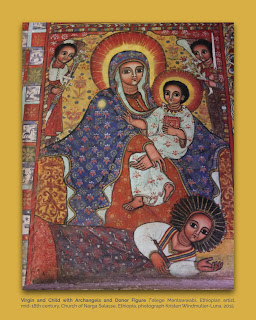
Virgin and Child with Archangels and Donor Figure (ˁətege Məntəwwab)
Tulane's Newcomb Art Department presents the 2022 Terry K. Simmons Lecture in Art History

Adapt, Reject, and Remix: Ethiopian Christian Art in the Early Modern Era 

Kristen Windmuller-Luna, Curator of African Art, Cleveland Museum of Art
March 14, 6:00 pm, Stone Auditorium

Abstract: The rulers of the Ethiopian Christian kingdom (1270–1974) and its predecessor the ˀAksumite Kingdom (ca. 1st–8th century CE) had long sought luxury goods from across Europe and Asia. Locally-made and imported art, textiles, and religious objects contributed to a cosmopolitan Ethiopian Christian visual culture well-documented in local visual and textual sources. This paper focuses on the early modern era, when a 1557–1632 European Jesuit mission introduced new Catholic art to the kingdom and trade with India grew. Contrary to earlier scholarship that minimized Ethiopian Christian art as “conservative” or “derivative,” Dr. Windmuller-Luna presents a series of case studies to show how Ethiopian artists asserted considerable agency and innovation in their use of non-local models by selectively remixing, adapting, and even rejecting foreign influences while simultaneously using historical imagery to communicate sacred and political messages.

Image:
Virgin and Child with Archangels and Donor Figure (ˁətege Məntəwwab), Ethiopian artist, mid-18th century, Church of Narga Śəlasse, Ethiopia, photograph Kristen Windmuller-Luna, 2015
 

Monday, December 20, 2021

Stephanie Porras awarded APS and CAA publication grants


Stephanie Porras
is the recipient of the 2021 Publication Grant awarded by the Association of Print Scholars (APS in support of her forthcoming book, The First Viral Images: Maerten de Vos, Antwerp Print, and the Early Modern Globe.

The book, to be published by Penn State University Press, considers how a single engraving, the painting upon which it is based, and an illustrated book, traveled and functioned across the globe.  Porras cites examples of the engraving's influence as a model for Spanish and American painters, Chinese printmakers, and Filipino ivory carvers. She proposes that, more than a story of migrant artists and objects, this book reconsiders the role of images in the uneven processes of globalization, beyond the transmission of artistic styles, ornament, or iconographic motifs. The publication aims to test art historical notions of copying and agency, context, and viewership.

Dr. Porras also received a grant from the College Art Association's Millard Meiss Publication Fund, which supports book-length scholarly manuscripts in the history of art, visual studies, and related subjects that have been accepted by a publisher on their merits, but cannot be published in the most desirable form without a subsidy.

Stephanie Porras is Associate Professor of Art History at Tulane University. She is the author of Pieter Bruegel’s Historical Imagination (2016), Art of the Northern Renaissance: Courts, Commerce and Devotion (2018) and co-editor of The Young Dürer: Drawing the Figure (2013). She currently serves as Reviews Editor for The Art Bulletin and is on the editorial board of the Nederlands Kunsthistorisches Jaarboek. Her forthcoming book, The First Viral Images: Maerten de Vos, Antwerp Print, and the Early Modern Globe, considers how a single engraving, the painting upon which it is based, and an illustrated book, circled the globe in the sixteenth and seventeenth centuries.

Monday, November 15, 2021

New art history course: Theories of Baroque Art


Judith Slaying Holofernes
Registration for Spring 2022 courses is now open! Prof. Leslie Geddes will be teaching a new history of art course, Theories of Baroque Art, on Thursdays at 3:30pm in the Woldenberg Art Center.

This seminar investigates innovations in artistic media, primarily painting, sculpture, and architecture, that can be described as Baroque in diverse locales, including its origins in Italy to its diffusion in the present day.   

How do we characterize the strange and fertile period of art production associated with the Baroque? What happened to art production following the High Renaissance? In the latter half of the sixteenth century and throughout the seventeenth century, there was an explosion of new approaches to art making in diverse geographies. This time coincides with cultural upheavals and religious wars in Europe, with scientific discovery and new geopolitical landscapes. The period known as the Baroque is a historical style characterization rife with misunderstandings. The name itself derives from a term used by Portuguese jewelers for deformed pearls (barrueco). How can we best understand this time of remarkable artistic production, its early and late critics, and how does understanding art help us make sense of the rapidly changing, expanding world of the Early Modern period? Register today!


Sites of Memory: New Orleans and Rio de Jainero


New Orleans and Rio de Janeiro images


TULANE'S SAWYER SEMINAR PRESENTS

SITES OF MEMORY: 
NEW  ORLEANS + RIO DE JANEIRO
EXPLORING DISPLACEMENT AND URBAN RENEWAL IN TREMÉ AND VALONGO WHARF 

This series of events highlights community activism in New Orleans and Rio de Janeiro as ways to challenge disinvestment in Afro-descendent neighborhoods, raising questions about the tendency for these places to be subordinated to outward-facing urban “renewal”.

December 7 | 6 pm
Screening of "Faubourg Tremé: The Untold Story of Black New Orleans”
In Stone Auditorium, 210 Woldenberg Art Center

December 10 | 3:30 pm 
Panel Discussion with Dr. Lorraine Leu, Sara Zewde, Freddi Williams Evans, Luther Gray
3rd Floor Newcomb Commons

December 12 | afternoon
Tour of the Tremé
Starting at the New Orleans African American Museum 

Tulane University’s 2021/2022 Sawyer Seminar, "Sites of Memory: New Orleans and Place-Based Histories of the Americas" – organized by the Newcomb Art Department and School of Liberal Arts and sponsored by the Andrew W. Mellon Foundation – takes New Orleans as a key case study for a broader understanding of settler-colonial, formerly slavery-fueled economies in the Americas using the theme of site-based public history and memorialization. 

For more information and questions about accessibility, contact ctucker6@tulane.edu or go online to sitesofmemorynola.org

Monday, November 8, 2021

Scholars honored at Tulane's first Research, Scholarship and Artistic Achievement Awards ceremony 

Elizabeth Boone inducted into the reserach hall of fame in an awards ceremony

The Office of Research held the first Tulane University Research, Scholarship and Artistic Achievement Awards on Thursday, Nov. 4, to honor outstanding Tulane scholars and recognize their exceptional research. Art History was well represented in the awards ceremony held at the Higgons Hotel in downtown New Orleans. 

Elizabeth Hill Boone was inducted into the Research Hall of Fame. Mia L. Bagneris received the Spirit of Tulane Award, which recognizes outstanding achievement of scholars whose work embodies Tulane’s motto, “Not for oneself, but for one’s own,” and enhances the university’s research mission. Prof. Bagneris and Adrian Anagnost received Funding Awards in recognition of their $225,000 grant from The Andrew W. Mellon Foundation to convene a year-long site-specific inquiry exploring changing historical narratives in New Orleans and the greater Gulf South region.

See Tulane News to read more about the ceremony and award reciepients. 

Monday, November 1, 2021

Ways of Looking – an invitation to thoughtful observation

The Carroll Gallery presents

Ways of Looking – an invitation to thoughtful observation 

The viewer is invited into the gallery space to experience art in a very conscious way. 
In the back galleries are two videos, with very different ways of communicating: Peach Body Summer by Ellen Bull presents a mysterious, open-ended narrative; The Thin Veil by Jane Cassidy provides an immersive sensory experience.   
 
The front gallery features a variety of selections from the Newcomb and Tulane Art Collections, with one area specifically featuring detailed work that benefits from closer viewing with a magnifying glass.  Another section of the gallery features works from those collections that have a story behind the artist that relates specifically to the Newcomb Art Department, and that context adds another layer of meaning to the work.  A third section of the gallery has three very different everyday objects on view for the visitor to observe carefully through the act of drawing.  Additionally, some resources on “slow looking” will be available to encourage visitors to thoughtfully engage with not only the artworks in galleries and museums, but also the visible world. 
 
Exhibition dates: November 8-24, 2022
Opening reception:  Sunday, November 7, 3 - 5 pm

For more information, contact Laura Richens (lrichens@tulane.edu).
 
[still from The Thin Veil by Jane Cassidy]

Friday, October 29, 2021

Award Winning Article

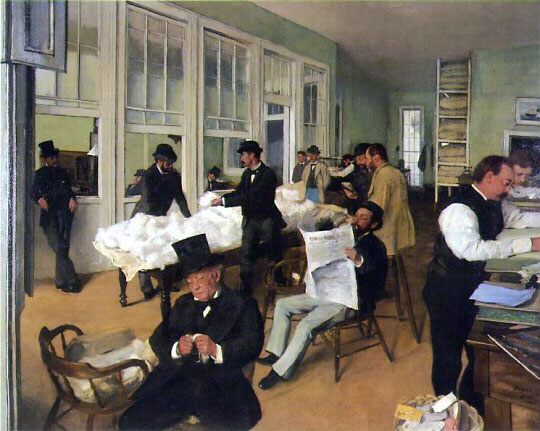
Prof. Michelle Foa’s article, “In Transit: Edgar Degas and the Matter of Cotton, between New World and Old,” The Art Bulletin 102, no. 3 (September 2020) was awarded the 2021 Article Prize by the Nineteenth-Century Studies Association.

Prof. Foa is currently at work on a book on Edgar Degas titled The Matter of Degas: Art and Materiality in Later Nineteenth-Century Paris, in which she analyzes the conceptual significance of the artist’s sustained experimentation with diverse media and techniques in the context of his investigation into the physical and material qualities of the world around him. 

[Edgar Degas, A Cotton Office in New Orleans, 1873, Musée des Beaux-Arts de Pau, France]