Tuesday, November 15, 2022
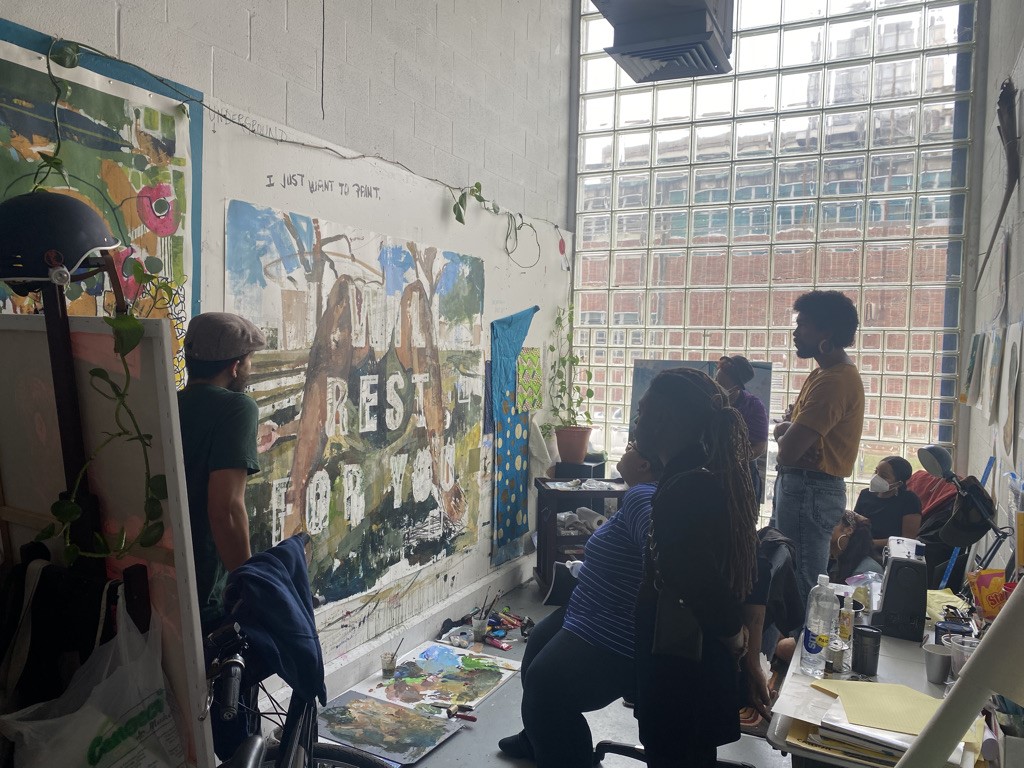
Black Arts Consortium Graduate Working Group Workshop

Anne Lafont: "Tying, publicizing, adorning: The buttons of Toussaint Louverture"

"Tying, publicizing, adorning: The buttons of Toussaint Louverture"
by Dr. Anne Lafont, École des hautes études en sciences sociales, Paris
Abstract The legend and reality of the 18 buttons kept at the Cooper-Hewitt Museum in New York force us to take a close look at their making in the latter part of the eighteenth century Caribbean and in the light of one of its most illustrious black personalities: Toussaint Louverture, pioneer of the Haitian revolution, emancipated slave, ally of the European powers, deposed prisoner and captured by Napoleon Bonaparte’s armies, who died in exile in a French dungeon. The function, iconography, medium and biographical fortune of this series of buttons inform an exceptional history where Caribbean, French and American figures intersect over two centuries. Unfolding the panoply of buttons and following their phenomenology, on a formal and social levels, from manufacture to use, is to write a piece of the history of art of the Black Atlantic.
Anne Lafont is an art historian and professor at the École des hautes études en sciences sociales in Paris. She is interested in the art, images, and material culture of the Black Atlantic, as well as in historiographical questions related to the notion of African art. She has published on art and knowledge in an imperial context, on gender issues in the art discourse of the 18th and 19th centuries, and more recently she published a book : L'art et la race. L'Africain (tout) contre l'oeil des Lumières. It was awarded the 2019 Fetkann Maryse Condé Literary Prize and the 2020 Vitale and Arnold Blokh Prize. Anne Lafont participated, as a member of the scientific committee, in the Musée d'Orsay exhibition The Black Model (2019). In 2021, she was awarded a residential fellowship from the cultural services of the French Embassy in the United States, the Villa Albertine, and served, for the academic year 2021-2022, as the Robert Sterling Clark Visiting Professor of Art History at Williams College (Massachusetts). Her most recent book : L'Afrique et le monde. Histoires renouées de la préhistoire au XXIe siècle (La découverte, 2022) is co-edited with François-Xavier Fauvelle.
Wednesday, December 7 2022 at 6:00 PM
Freeman Auditorium, Woldenberg Art Center
View Map
This lecture is supported by the Sandra Garrard Memorial Fund.
Friday, November 4, 2022
Objects in Focus: Clothes by Betsy Packard, MFA 1978
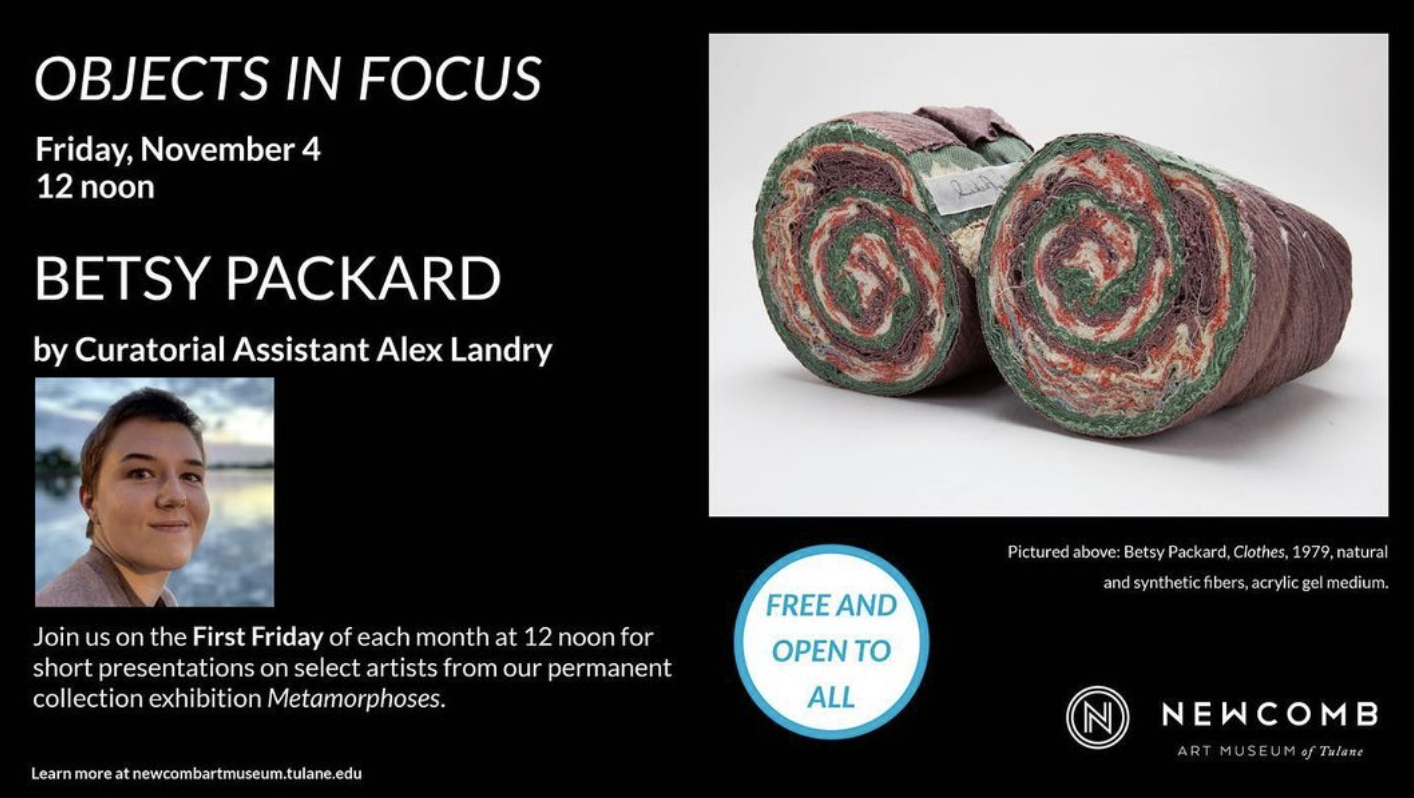
Friday, November 4, 12 pm
Newcomb Art Museum
This talk will be led by Alex Landry, Curatorial Assistant at the Newcomb Art Museum and a 2nd-year Art History MA student.
This event is free and open to all.
Friday, October 7, 2022
"Paper, Ivory, Feathers: Viral Materiality in the Early Modern World"

Stephanie Porras: "Paper, Ivory, Feathers: Viral Materiality in the Early Modern World"
Fri, Oct 14, 2022 | 12:15 - 1:30 pm
1210 Heller Hall, University of Minnesota
Minneapolis, MN 55455
Event Registration
Cosponsored by the Department of Art History and the Early Modern Atlantic Workshop.
This is a hybrid event. Click the registration link to sign up for the Zoom webinar.
Tuesday, October 4, 2022
Ina Kaur: artist residency at MIAD

During her visit Ina engaged the MIAD community through an artist lecture and was part of the panel "Contemporary art practices: artistic journey across cultural boundaries and ethnic borders." The works created during the residency are on display at the MIAD galleries until Oct 08, 2022.
Ina's interdisciplinary practice uses various mediums, and she continues to push the material boundaries in her work. Her newest project titled, “coloniality of expression” utilized lithography, etching, ceramics and stitching.
#miadprints2022 #miadprintmaking #tulaneart
IG: @studio_inkspace
Dr. Anagnost's new book reviewed in Art Journal
"Anagnost has done a superb job of reuniting the discussions of art and architecture, reminding us of the intense exchanges between people working on different media and at different scales."

Professor Adrian Anagnost’s new book Spatial Orders, Social Forms: Art and the City in Modern Brazil (Yale University Press, 2022) is reviewed by Fernando Luiz Lara in the current issue of Art Journal.
Dr. Adrian Anagnost is Associate Professor of Art History at Tulane. Her new book explores the intersections among art, architecture, and urbanism in Brazil from the 1920s through the 1960s. It shows how modernity was manifested in locally specific spatial forms linked to Brazil’s colonial and imperial past. Discussing the ways artists and architects understood urban planning as a tool to reorganize the world, control human action, and remedy social problems, Anagnost offers a nuanced account of the seeming conflict between modernist aesthetics and a predominately poor and historically disenfranchised urban public, with particular attention to regionalist forms of urban development.
Dr. Fernando Lara is the Potter Rose Professor in Urban Planning at the School of Architecture at the University of Texas at Austin.
Citation: Fernando Luiz Lara, review of Modernity for the Masses: Antonio Bonet’s Dreams for Buenos Aires and Spatial Orders, Social Forms: Art and the City in Modern Brazil in Art Journal 81, no. 3 (2022): 116-118, DOI: 10.1080/00043249.2022.2110425
Monday, October 3, 2022
Adrian Anagnost and Leslie Geddes - “Military Ecologies in the Americas: The French Fort of La Balise”

Abstract: The French fort of La Balise, built in the early eighteenth-century, was at the nexus of marshland and sea in the Mississippi River Delta. Originally, the fortified settlement aimed to protect French colonial interests and secure access to the Mississippi River at a crucial juncture. Today, due to land loss along the Gulf of Mexico, the fort lies underwater at most tides, but visual evidence remains: a series of ink and watercolor maps produced for administrative oversight and sent to the Dépôt des Fortifications des Colonies.
Recognizing both advantages and hazards of the landscape, these maps document the enmeshment of fort and the Mississippi Delta’s complex ecosystem. Passage from the Gulf of Mexico to the river was fraught with peril, evident in references to shipwrecks alongside pictorial and textual demarcations of currents and oceanic depths. Simultaneously, French mercantile and social orders were imposed on the landscape, with a brickyard and designated settlement for enslaved Africans on an adjoining island. Exploitation of natural resources and racialized spatial segregation were formative to the colonial project in the Americas. We argue that depictions of the fort’s construction, amidst the ever-shifting environs of the Gulf South, reveal how topographic variability posed difficulties to pictorial rendering. Troubling rigid conceptualizations of landscapes and seascapes, maps reveal interpenetrating salt and freshwaters, shoals, and islands. As the French sought to make militarily secure this mutable terrain, the land itself challenged visual discernment, with colonial expansion, imperial power, and enslavement set against a natural landscape that thwarted cartographic fixity.
Subscribe to:
Posts (Atom)